What I asked about Rising Costs, Taxes, and Accountability
Dear Friends and Neighbors,
My most recent Senate Budget Subcommittee hearing focused on the agencies responsible for tax collection and administration in California – the California Department of Tax and Fee Administration and the Franchise Tax Board.
We examined how California collects, manages, and distributes tax revenue – and how those decisions impact local communities. That includes tax-sharing agreements, revenue recovery contracts, and the growing use of outside consultants and data-driven tools in how public funds are allocated.
This isn’t abstract – we are already feeling the effects of state tax policy, even if we don’t always see how it works. It shows up in rising local fees, pressure on small businesses, higher energy costs, and growing frustration when people can’t get clear answers about why costs are going up.
At a time when families are already stretched thin, trust in how decisions are made matters more than ever.
In this hearing, I asked direct questions:
- Are tax-sharing agreements between local governments and private businesses being used in ways that shift costs onto taxpayers without transparency?
- Who is benefiting from these arrangements—and who is paying the price?
- And are we helping taxpayers—or exposing them?
What we’re seeing is concerning.
We all want more transparency. As more data becomes public it can be aggregated, modeled, and used by outside consultants to gain leverage over cities and counties. In some cases, information meant to promote transparency may actually be creating a roadmap for how to extract more from taxpayers.
At the same time, some contracts may include nondisclosure provisions – making it harder for the public to understand why decisions are being made.
In simple terms: the rules haven’t kept up with how data and technology are being used – and taxpayers could be left exposed.
As Chair of this budget subcommittee, I will continue pushing for stronger oversight, better safeguards, and real accountability. That includes follow-up actions, deeper review of these practices, and ensuring our systems are designed to protect the public – not be used against them.
This same principle applies to energy.
Last year, I worked to secure financial support for refinery operations because we cannot ignore the consequences of losing in-state energy production.
The Governor has proposed support for sustainable aviation fuel production. While I don’t support a “bailout or else” approach, we have to be honest about the risks – not just to our energy supply, but to jobs and local economies across California. If state bureaucrats expect industries to transition – and some refineries already have – we must stand with the workers, communities, and consumers who rely on that work.
This support can help prevent refinery closures and protect good-paying jobs here in California – but it must come with balance and strong accountability.
Additionally, I questioned the Franchise Tax Board on a request for an additional $17 million for an IT project that has already been ongoing for nearly a decade. While I’m not a technology expert, this does not pass the sniff test. I pushed both the Department of Finance and the Legislative Analyst’s Office on why there has been limited scrutiny and insufficient explanation on this request.
Because at the end of the day, transparency should protect you – not be used against you. And I’ll keep fighting to make sure it does.
My very best to you and your families,
Melissa Hurtado
State Senator, 16th District
Meet the 2026 Woman of the Year for
Senate District 16
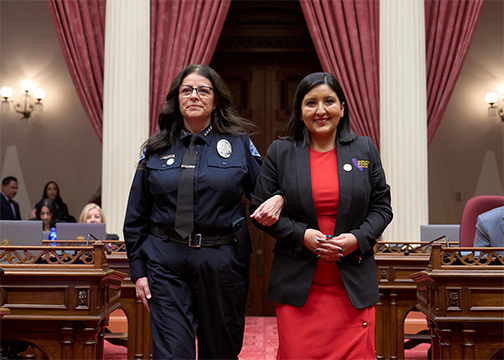
On March 16th, the California State Senate honored Corcoran Police Chief Margarita “Maggie” Ochoa as the 16th Senate District Woman of the Year.
Rooted in the heart of the Valley, Chief Ochoa embodies the sacred bond of family, the fight for community safety, and the enduring values of hard work and resilience. As Corcoran’s first female and Latina police chief, she has broken barriers while protecting our families with both fierce and compassionate strength — reflecting the path many women take to claim their place in leadership. Her quiet Valley resilience turns adversity into advocacy, making public safety a promise kept for our children.
Chief Ochoa was named Chief of Police in Corcoran in 2024 after 24 years of service as an officer with the Lemoore Police Department, where she consistently achieved positions of increased responsibility.
In addition to her primary law enforcement responsibilities, Chief Ochoa has served as a public safety instructor for the Kings County Office of Education and as adjunct staff for the Tulare Kings Police Academy. Chief Ochoa has also contributed extensively to numerous county and regional multidisciplinary teams and advisory committees.
A first-generation college graduate with degrees in Administration of Justice, Criminal Justice Management and Organizational Leadership, Chief Ochoa began her career in law enforcement at the age of 21 as a reserve officer with the King City Police Department.
The annual legislative “Woman of the Year” celebration was founded in 1987 by Assemblywoman Bev Hansen (R) and Assemblywoman Sally Tanner (D) after they noticed that there were no events planned for the month of March recognizing Woman’s History Month. They arranged to invite one woman from each of the 120 California State Senate and Assembly Districts, to celebrate and honor their accomplishments. This has become an annual event, organized by the California Legislative Women’s Caucus as a way to celebrate the contributions women make to society.
Senator Melissa Hurtado currently represents the 16th Senate District in the California Legislature, which includes portions of Fresno, Tulare, Kings and Kern Counties. Senator Hurtado is Chair of Senate Budget Subcommittee No. 4, and a member of the Senate Banking and Financial Institutions Committee, the Budget and Fiscal Review Committee, the Energy, Utilities and Communications Committee, the Environmental Quality Committee, the Governmental Organization Committee, the Joint Legislative Budget Committee and the Joint Legislative Committee on Climate Change Policies.